

 Contact





Regenerative Medicine at Our Clinic

What Is Regenerative Medicine?
This is a medical approach that restores the function of dysfunctional or damaged biological tissues by effectively harnessing the body’s natural self-healing abilities. In the field of orthopedics, this type of treatment is referred to as “biotherapy.” At our clinic, we offer PRP therapy (APS) as a form of regenerative medicine, as well as synovial stem cell transplantation—a treatment for which only a few facilities in Tokyo have been granted approval.
PRP (APS) Therapy
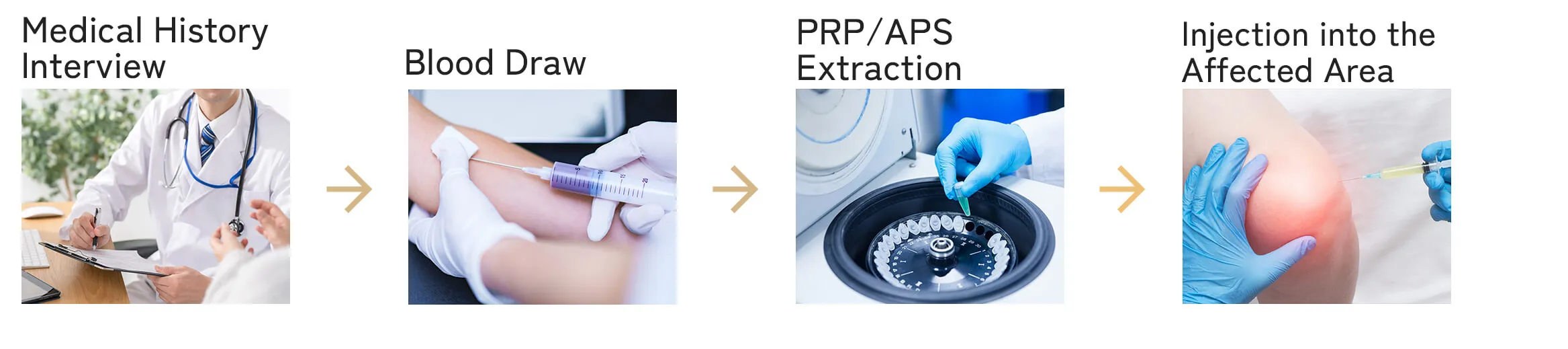
APS is produced by further centrifuging and dehydrating PRP to extract high concentrations of proteins that help suppress inflammation and growth factors that protect cartilage. Also known as “next-generation PRP,” it is expected to be more effective than standard PRP in reducing joint pain and inflammation, as well as in inhibiting cartilage degeneration and destruction.
This treatment involves injecting APS—derived from the patient’s own blood—into the affected area (target condition: osteoarthritis of the knee). APS is produced using a medical device approved by the Ministry of Health, Labour and Welfare as a medical device whose safety for therapeutic use has been confirmed. Generally, tissue repair begins within about 1 to 4 weeks, and effects are expected to be seen within 2 weeks to 3 months after treatment. Additionally, treatment reports from overseas indicate that a single injection of APS can provide lasting benefits for up to approximately 24 months.
*All treatments are completed on the same day.
-
-
About the Effects and Benefits of Treatment
- Since this treatment uses the patient’s own blood, the risk of side effects—such as infection or allergic reactions—is extremely low.
- It can be easily prepared from the patient's own blood, and the procedure can be performed on an outpatient basis.
- Since the treatment consists only of a blood draw and an injection, there is no upper age limit.
- Since the treatment leaves no scars, you can receive it repeatedly.
-
About the Drawbacks and Side Effects (Disadvantages) of Treatment
- Since the effectiveness of APS depends on the extent of tissue damage or joint deformity (reports generally indicate that effectiveness decreases as the condition becomes more severe), it may be difficult to achieve consistent results in some cases (treatment outcomes and the duration of effectiveness vary from person to person).
- The therapeutic effects may be noticeable immediately after the injection, or they may appear 1 to 2 months after the first injection, following several subsequent injections.
- The therapeutic effect lasts from several months to about two years on average, and in many cases it is not permanent.
-
During the procedure, the injection into the affected area may cause some pain.
In addition, after the procedure, severe inflammatory pain may persist for one to several days at the injection site—such as in the joints or the Achilles tendon. -
Subcutaneous bleeding (bruising) may occur at the blood draw site or treatment site.
-
There is a risk of swelling, pain, a sensation of heat, or bruising following the injection, but these symptoms are temporary.
Please consult us if your symptoms are severe. To quickly relieve swelling and heat, we recommend medication or cooling.
-
There is a risk of swelling, pain, a sensation of heat, or bruising following the injection, but these symptoms are temporary.
-
During this treatment, up to approximately 60 ml of blood will be drawn. While this is more than the amount drawn during a typical blood test, it is a smaller volume than the 200 ml or 400 ml typically donated during a blood drive.
However, in very rare cases, some patients may experience lightheadedness or feel unwell during the blood draw. - Although this treatment falls under the category of regenerative medicine, its primary focus is on pain relief, and there have been no reports of favorable results regarding cartilage regeneration.
- Please note that treatment results and their duration may vary depending on factors such as your age and physical condition at the time of treatment, as well as individual differences, since your own blood is used.
-
Treatment Costs
Blood Volume Drawn Injection Volume Treatment Fee APS 55ml 2.5ml ¥350,000
Synovial Stem Cell Therapy
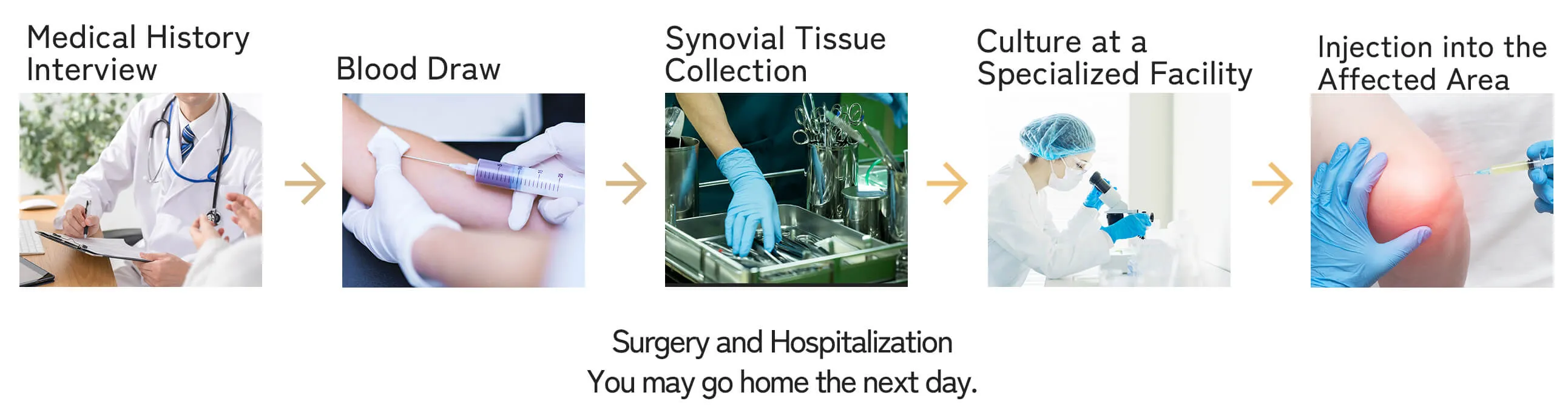
The synovium is a tissue that produces joint fluid from its surface layer and plays an important role in allowing the joints to move smoothly. Years of basic research have revealed that synovial stem cells have an excellent ability to form cartilage, and this has been put into practical use as a treatment for the knee joint. The procedure is extremely simple: synovial tissue is harvested from the patient, the stem cells are cultured, and they are then injected into the knee joint with the aim of relieving symptoms.
In May 2024, our clinic was certified to provide this treatment as self-pay regenerative medicine, making it the third approved facility in Tokyo.
-
About the Effects and Benefits of Treatment
- This treatment can be expected to relieve pain and help prevent the progression of knee osteoarthritis.
- Because synovial tissue itself has a high regenerative capacity, harvesting it has almost no adverse effect.
- Because the patient's own cells and autologous serum are used to culture the synovial stem cells, the risks of rejection and infection are extremely low.
- As the treatment is given by injection, it places less burden on the body than surgery.
-
About the Drawbacks and Side Effects (Disadvantages) of Treatment
- You may feel unwell during the blood draw.
- Anesthesia is used to harvest the synovial tissue, so anesthesia-related complications may occur.
- Swelling and pain may occur at the site where the synovial tissue was harvested.
- Even after treatment, the effect may be weak, or there may be no effect at all.
- If the joint is not moved after treatment, it may become stiff.
- This treatment is not covered by public health insurance, such as Employees' Health Insurance or National Health Insurance, so the full cost is paid by the patient.
-
Treatment Costs
This treatment is self-pay and not covered by public insurance; the treatment fee set by our clinic will be charged.
Treatment Fee (One Knee) ¥2,750,000 ■Includes consultations, blood tests, the blood draw for autologous serum, synovial tissue harvesting, synovial stem cell injection, and follow-up visits at 1, 3, and 6 months after the injection.
■Synovial tissue is harvested arthroscopically and requires hospitalization; the hospitalization cost is included in the treatment fee. -
Who Cannot Receive This Treatment
- Patients undergoing cancer treatment
- Patients with an infectious disease
- Patients with a fever
- Patients with drug hypersensitivity
- Patients taking immunosuppressants
Safety
Regenerative medicine (APS and synovial stem cell therapy) is not available at every hospital; it can only be provided by medical institutions whose notification has been accepted by the Ministry of Health, Labour and Welfare.
Under the Act on the Safety of Regenerative Medicine, our clinic has submitted a Plan for Provision of Class II Regenerative Medicine, which has been accepted.
Setagaya Tamagawa Orthopedic Surgery Internal Medicine Clinic
Director: Yasunori Tsukimura